Choosing Outdoor Weaving Material: A Specifier's Guide
How architects and furniture brands evaluate synthetic weaving substrates for outdoor and hospitality projects — UV, fire, food-contact, and gauge tolerance.

Outdoor projects punish the wrong material choice. Furniture that looks perfect in a showroom can fail within two seasons — colours fading, fibres becoming brittle, weave loosening. Most of these failures are preventable when the material is specified correctly from the start.
Here are the four properties experienced specifiers always evaluate before selecting a weaving substrate for an outdoor project.
What actually fails outdoors
Weaving material failures in outdoor settings almost always originate from one source: consistent UV exposure.
In tropical climates — high UV index year-round, humidity above 70%, and intermittent rain — materials that are not properly compounded will show signs of degradation within the first 6–12 months:
- Uneven colour fading — particularly in pigments that are not UV-stable. Dark colours such as navy and black are most quickly affected
- Fibres becoming brittle — polymers without UV stabilisers undergo photo-oxidation that weakens the molecular structure. Fibres that were once flexible become rigid and prone to cracking
- Surface crazing — micro-cracks appearing on the fibre surface after several months of exposure
- Weave loosening — as fibres lose elasticity, weave tension reduces and gaps between strands begin to form
For hospitality projects where furniture is used daily and replaced only when visibly deteriorated, these failures are not just aesthetic — they are an operational cost problem.
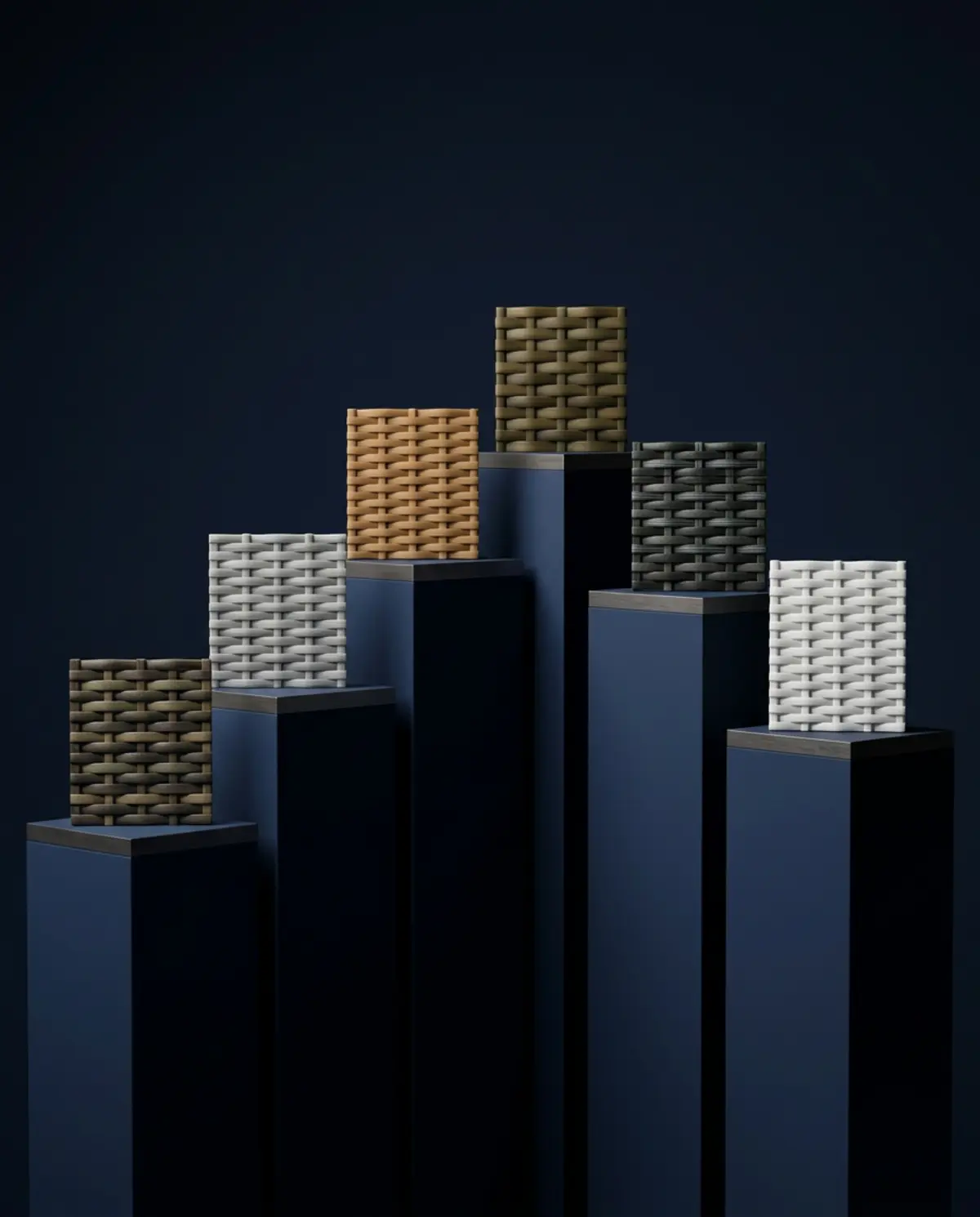
The four properties that matter
1. UV Stability
This is the most fundamental property for outdoor applications. A quality weaving substrate must use UV-stable pigments mixed directly into the polymer compound — not a surface coating that can peel over time.
The relevant test standard: ASTM G154 (accelerated UV exposure). Request grey scale rating data after a minimum of 1,000 hours of exposure. A rating of 4–5/5 on the ISO Grey Scale is an acceptable benchmark for hospitality projects.
One important note: UV ratings claimed by suppliers must be verifiable through independent laboratory reports. Claims without data are claims without value.
2. Flame Retardancy (for specific applications)
For projects with strict building codes — facades, secondary skins, ceiling panels, and public interiors — weaving substrates must meet flame propagation requirements.
HB classification under ASTM D635 is the minimum standard generally accepted for architectural applications. This classification means the material is self-extinguishing when the ignition source is removed — the flame stops on its own, it does not propagate.
Important to understand: flame retardancy is a compound property, not a surface treatment. Material that has been spray-coated with FR treatment after production does not provide the same protection as material compounded with FR additive from the start.
3. Food-Contact Compatibility
Relevant for dining, resort, and hospitality projects where the material comes into contact — directly or indirectly — with food or food-contact surfaces.
Raw materials that are food-grade certified (complying with EU Regulation No. 10/2011, FDA 21 CFR §178.3297) ensure no migration of harmful substances under normal use conditions. This should not be a paid upgrade — for serious suppliers, it is the default.
4. Gauge Tolerance and Dimensional Consistency
This property is often overlooked but critically important for consistent weaving. Strand thickness variation exceeding ±0.2mm will produce an uneven weave — particularly visible in flat weave and herringbone patterns.
For large-scale projects (facade panels, furniture in volume), dimensional consistency across production batches is also important. Request written dimensional tolerances from the supplier before placing a production order.
How Nextouch tests for them
Nextouch materials are independently tested by SGS — a testing and certification body operating in more than 140 countries — covering UV exposure (ASTM G154) and flame propagation (ASTM D635).
All pigment raw materials use food-grade certified formulations meeting EU, FDA, and Japan Food Sanitation Act standards.
Full reports are available to qualified procurement teams. For project specification or technical data requests, start with a physical sample — the most direct way to evaluate material quality before committing to an order.